

EGG FREEZING
What Is Egg Freezing
Egg freezing is a preventive medical method, with a cost similar to that of in vitro fertilisation (IVF), which has revolutionised the way women can manage their fertility and choose to have children when they wish. With cryopreservation, a woman’s eggs are collected under sedation through the procedure of egg retrieval (collecting eggs from the ovaries with medical techniques), after an ovarian stimulation process with special injections for about 10 days. These eggs are frozen using the vitrification method, which preserves the integrity of the eggs during freezing and thawing for future use. The storage of frozen eggs may be extended up to the age at which a woman is legally allowed to have a child through IVF (54 years under current legislation). The quality of frozen eggs does not deteriorate over time and is best when the woman is younger at the time of egg retrieval.
General Information
When a woman is born, as a newborn, she has 2,000,000 eggs. By the age of onset of menstruation, this number decreases to 400,000. By the age of 30, the number has fallen to 100,000 eggs, while by the ages of 45–55, when a woman enters the climacteric/menopause, they are minimal or drop to zero.
Female fertility decreases over time, both due to a reduction in the number of eggs and due to a decline in their quality. This decline appears to accelerate after the age of 36–37, while after the age of 42 the likelihood of pregnancy is extremely limited, both naturally and through IVF.
When Is It Indicated
Egg freezing is indicated for:
● fertility preservation over time. A woman collects and stores her eggs at a younger age so that she can use them when circumstances are right.
● fertility preservation in cases where the body has been affected by conditions (cancer, autoimmune diseases, etc.) and their treatments, or when a considerable amount of time is required after treatment before childbearing is permitted.
Egg Freezing Procedure
The egg freezing procedure is simple and includes:
● ovarian stimulation with the appropriate preparations/injectable medications, so that a satisfactory number of follicles develop in the ovaries—similar to multiple ovulation.
● monitoring with 3–4 ultrasounds and hormonal testing (blood tests), which lasts about 10 days.
● egg retrieval (collection of eggs from follicles), performed under light sedation and is painless. It lasts 15–30 minutes depending on the number of follicles.
● cryopreservation. After retrieval, the eggs are assessed by the clinical embryologist for quality and maturity stage, frozen using the modern vitrification method, and stored in liquid nitrogen (-196°C).
Side Effects - Risks
Egg freezing is a safe procedure, but like any medical intervention, it may be associated with side effects. The most common include:
● irritation at the injection site, temporary abdominal bloating, constipation, and mild pain or discomfort after egg retrieval.
● ovarian hyperstimulation syndrome (OHSS), a rare complication that can cause abdominal pain, nausea, vomiting, or even require hospitalisation in severe cases.
● a small risk of infection or bleeding from egg retrieval.
As for children born from frozen eggs, research has not shown an increased risk of genetic or chromosomal abnormalities compared to children born from fresh eggs. However, childbearing at an older age may increase the risk of complications during pregnancy, such as hypertension and diabetes.
Also, large-scale epidemiological studies involving hundreds of thousands of women who underwent IVF with or without hormones did not identify differences in breast cancer incidence between the two groups. Nevertheless, hormones should be administered at the lowest possible doses and for the shortest possible period, in line with modern principles of reproductive endocrinology. This is achieved when a woman freezes her eggs at a younger age, since with smaller medication doses we can collect more eggs of better quality.
Cost
The cost of egg freezing varies depending on the complexity of the process and includes expenses for medical tests, hormonal medications, egg retrieval, and storage (annual storage fee).
Frequently Asked Questions
At What Ages Can Egg Freezing Be Done?
The younger the woman, the better the quality and quantity of the eggs and the higher the chances of a future pregnancy. Also, younger women require smaller amounts of medication to achieve the desired result. The age range 25–36 is considered ideal for these reasons. Nevertheless, the procedure can also be performed at 38, 39, at 40, or even at 42. It is important that, once the decision to freeze eggs has been made, it is done as early as possible, and not at 43 or at 45. According to studies, the percentage of eggs suitable for childbearing is only 8%, which underlines the importance of timely action.
Why Freeze Eggs at a Young Age
By choosing egg cryopreservation at a young reproductive age (<36 years), a woman:
● secures a large number of eggs on the first attempt
● preserves higher-quality eggs for the future. As a woman gets older, egg quality declines; therefore, collecting and freezing eggs at a younger age results in lower rates of chromosomal and other abnormalities
● achieves her goal with fewer medications
● avoids multiple IVF attempts at an older age
● can continue pursuing her life goals (educational, professional, social, etc.), with increased chances of having a child when she chooses
● chooses the right relationship without the pressure of the “biological clock”
● has a higher chance of having a child using her own genetic material, even at an older reproductive age, if she decides to.
How Many Eggs Should I Freeze
The desired outcome of egg cryopreservation is the birth of a child/children from these eggs. Optimal results are achieved when a woman has frozen 12–15 eggs, as it is not guaranteed that every frozen egg will survive thawing, be fertilised, and develop into a viable ongoing pregnancy that results in the birth of a child.
What Happens When I Decide I Want to Get Pregnant?
The eggs are frozen using the vitrification method in the laboratory, where they can be stored for many years without any loss of quality. When a woman decides to have a child, the eggs are thawed and prepared for fertilisation in the laboratory together with her partner’s sperm.
What Are the Success Rates?
With newer methods of cryopreservation and restoration (thawing), egg survival may reach up to 95%. From the moment of cryopreservation, time has essentially stopped and egg quality remains unchanged until thawing. When a woman chooses to have a child, depending on her age and other factors, she will try naturally, and if unsuccessful, she will then proceed to use the cryopreserved eggs through IVF.
It is important to understand that egg cryopreservation greatly increases the chances of having a child at an older reproductive age, but it does not guarantee it. The procedure is done so that there is an option and possibility.
How Long Can Frozen Eggs Be Stored?
Under Greek legislation, the maximum permitted duration of egg cryopreservation is 20 years and it can be extended for an additional 5 years with the submission of a written request.
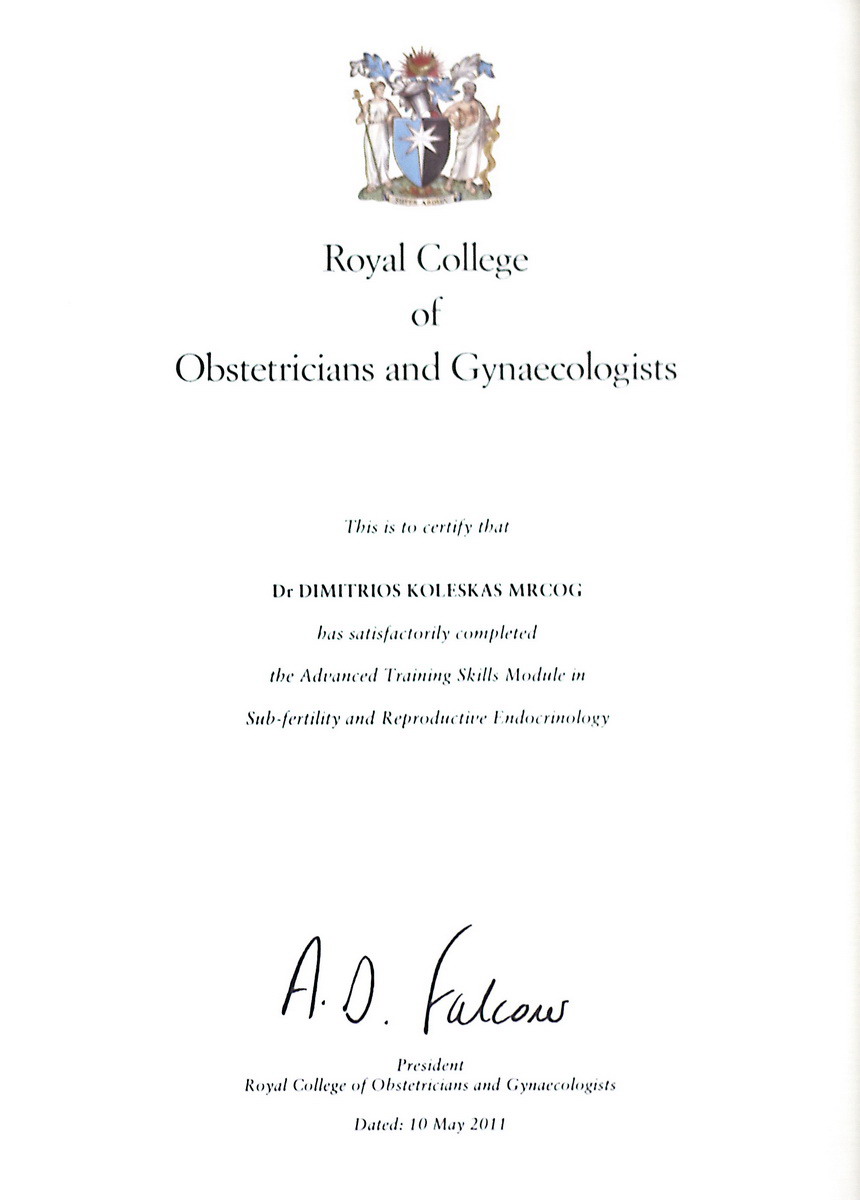
The distinguished obstetrician, surgeon gynaecologist D. Koleskas, M.R.C.O.G., C.C.T., has more than 20 years of practical experience in obstetrics and gynaecology and is specialised in human reproduction and endocrinology by the Royal College of Obstetricians and Gynaecologists of the United Kingdom (RCOG). For more information, please contact the doctor and schedule your appointment. To learn more about how egg freezing is done and up to what age, please contact the doctor and schedule your appointment.