

In Vitro Fertilisation (IVF)

In Vitro Fertilisation (IVF)
What Is In Vitro Fertilisation (IVF)?
In Vitro Fertilisation (IVF) is the most widely used assisted reproduction technique. It has been applied in humans since 1978 and, since then, millions of children have been born with the help of IVF.
As its definition suggests, IVF involves combining sperm and eggs outside the woman’s body, in an embryology laboratory, where fertilisation takes place and embryos are created (In Vitro Fertilisation, IVF). Laboratory conditions are strictly controlled and, together with the experience gained over the years, IVF has achieved improved success rates in recent years.
When Is It Recommended?
IVF is recommended in cases where there is a serious infertility problem that cannot be effectively treated with other methods.
More specifically, IVF may be recommended when the following apply:
● absence of the fallopian tubes or tubal blockage
● azoospermia, or a very low number of motile, normally shaped sperm
● quantitative or qualitative egg problems in women over 37 years of age
● long duration of infertility
● advanced maternal age
● unexplained infertility
● severe endometriosis
IVF may also be recommended for couples with a history of cancer or for the prevention of inherited diseases through preimplantation genetic testing/diagnosis.
How IVF Is Performed
The procedure begins with the collection of eggs from the woman’s follicles through egg retrieval. In the laboratory, the eggs are placed in special dishes with culture medium and are brought into contact with sperm in order for fertilisation to occur. After fertilisation, the zygotes (fertilised eggs) are placed in an incubator for 2–6 days, where they go through the early stages of embryo development under controlled conditions. The embryologist loads the embryos into a catheter, and the gynaecologist places them into the uterus using a thin catheter. The embryos then implant naturally into the uterine lining (endometrium), as would happen in a natural conception. If implantation is successful, pregnancy begins.
Symptoms that may follow a successful IVF cycle are similar to those of a typical pregnancy, such as mild fatigue, sleepiness, mild lower abdominal discomfort, and light spotting 5–7 days after embryo transfer.
IVF Procedure / Stages
The IVF process is painless and consists of a series of key stages, including:
● ovarian preparation with birth control pills or hormones to improve response to stimulation. This step is not necessary in all cases.
● ovarian suppression with GnRH analogues (GnRH-analogues) – long agonist protocol
● ovarian stimulation (ovarian stimulation medications)
● prevention of ovulation as follicles grow and multiply (GnRH antagonists). This is performed in parallel with stimulation – antagonist protocol
● from the start of stimulation to egg retrieval, it usually takes 11–13 days, during which 3–4 appointments are scheduled for ultrasound scans and blood tests to assess ovarian response
● administration of the trigger injection for inducing final oocyte maturation/ovulation trigger (Pregnyl, Ovitrelle)
● egg retrieval under light sedation. A transvaginal ultrasound is performed and a fine needle passes through the vaginal wall to aspirate follicular fluid containing the eggs. The retrieval is short and relatively safe. About one hour after completion, the woman can return home, and from the next day she can resume normal activities.
● sperm production by the husband/partner
● fertilisation and embryo development in the laboratory under embryologist supervision, resulting in day-1 embryos
● embryo transfer, where 1–3 embryos are transferred into the uterine cavity (endometrium) on day 2 to day 5 after egg retrieval
The entire process is supported with medication. Around 10–12 days after embryo transfer, a blood test for beta hCG (chorionic gonadotropin) is performed to confirm whether pregnancy has been achieved. If the test is positive, a transvaginal ultrasound is performed about two weeks later to visualise the early pregnancy.
IVF Techniques
IVF can be performed using various techniques, such as:
● Conventional IVF. The most common method, where sperm and eggs are placed together in culture medium to allow fertilisation, after which embryos are transferred to the uterus. It is preceded by medications that stimulate the ovaries to produce multiple mature follicles at the same time. Having a larger number of high-quality eggs is an important factor in success.
● Natural cycle IVF. The procedure is still carried out in an embryology laboratory, but it relies on a single egg released naturally during the woman’s monthly ovulation. In other words, it follows the woman’s natural menstrual cycle without ovarian stimulation drugs. However, this technique has lower success rates compared to conventional IVF.
● Assisted Hatching. A technique used before embryo transfer, either after conventional IVF or after ICSI. It involves thinning or creating a small opening in the embryo’s outer оболка (zona pellucida) to facilitate hatching and implantation. It is mainly used when the membrane is thick/hard, in older women, or in cases of repeated IVF failure.
● Intracytoplasmic Sperm Injection (ICSI). Used when sperm have difficulty penetrating the egg due to male-factor infertility such as low motility or abnormal morphology. Eggs are cleaned and the most mature are selected. ICSI is performed 2 to 10 hours after egg retrieval, and a single sperm is injected directly into the egg through a specialised needle.
● IVF with donor eggs and/or donor sperm. Depending on the medical history of a couple—or even an individual—IVF may be carried out using a donor, meaning eggs from a donor, sperm from a donor, or both may be needed.
● IVF with blastocyst transfer. A blastocyst is the embryo stage reached 5 to 6 days after egg retrieval. In conventional IVF and ICSI, embryos are often transferred 2–3 days after retrieval. Blastocyst transfer offers the advantage of selecting higher-quality embryos, as development can be observed for longer. However, there is a risk that no embryos survive to the blastocyst stage, making transfer impossible.
● Cryopreservation of embryos and testicular tissue. Performed in liquid nitrogen tanks at −196°C. When multiple embryos are available or when conditions for implantation are not ideal, embryos can be frozen and stored for transfer at a more suitable future time.
● Preimplantation Genetic Diagnosis (PGD). This refers to detecting genetic disorders in embryos, followed by selecting and transferring only unaffected embryos. It is performed in combination with assisted reproduction techniques such as IVF or ICSI. In Greece, this technology is available for specific conditions, with common applications including cystic fibrosis and beta-thalassaemia.
Is It a Safe Method? Since 1978, millions of children have been born through IVF. Children born through IVF show similar rates of chromosomal and genetic abnormalities compared to those conceived naturally. The effect of the couple’s underlying infertility on the health of these children is not clearly known. The medications used during IVF are considered safe when taken at the appropriate dosages and when cycles are kept within a reasonable number. There is no evidence in the scientific literature proving an association between breast cancer and IVF.
Success Rates
Achieving a successful pregnancy depends on a range of factors, which may be divided into obvious and less obvious ones. Obvious factors include the quality and number of embryos, the woman’s age, sperm quality, and the cause of infertility. Less obvious factors include the expertise of doctors, embryologists, midwives and other specialists involved, as well as the infrastructure and quality control of the laboratory.
It is also important to note that the woman’s age plays a major role. It is widely accepted worldwide that as age increases, success rates of pregnancy and live birth of a healthy child decrease significantly.
In general, the clinical pregnancy rate per embryo transfer ranges between 30–40%, with better outcomes in women under 35–38 years. Overall, success rates may reach 60–65% after 3–4 attempts. However, after the age of 43, success rates drop to around 5%.
What Is the Cost of IVF?
Methods and approaches are often adjusted throughout treatment, which makes it difficult to calculate the total cost from the outset. In addition, the cost is not limited to the procedure itself, but may include other related expenses such as medications, cycle monitoring, IVF techniques, and additional technologies.
What If It Fails? Achieving success on the first IVF attempt is the desired outcome for both the couple and the medical team. However, when IVF fails, there are various steps that can be taken to address the situation and improve the chances of success in subsequent attempts. After an unsuccessful cycle, it is important to perform a thorough evaluation to identify possible causes of failure, and to provide appropriate psychological support from mental health professionals, as IVF failure can have serious psychological effects including anxiety and depression. In many cases, couples can achieve pregnancy after multiple IVF cycles. Overall, IVF is a complex process, but with the right approach and support, the chances of a successful IVF outcome can increase significantly.
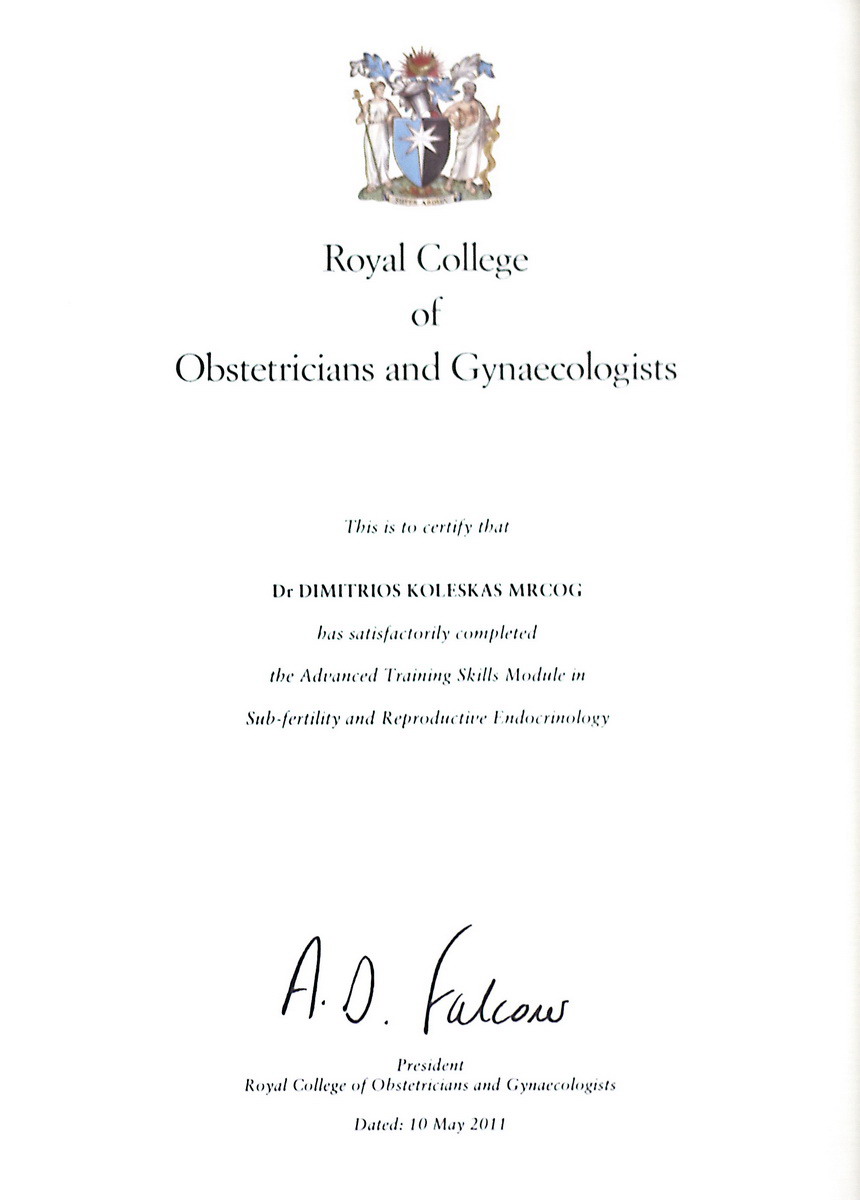
The obstetrician and surgeon gynaecologist M.R.C.O.G., C.C.T., D. Koleskas, has excellent theoretical training and more than 22 years of experience. With a patient-centred approach, he provides high-quality care based on modern scientific knowledge and medical safety. He is specialised in human reproduction and endocrinology by the Royal College of Obstetricians and Gynaecologists of the United Kingdom (RCOG). For more information about what IVF is, please contact the doctor and schedule your appointment at his practice in Athens.